Cannabis Grow Guide
— Seed to Harvest
Every stage of the cannabis lifecycle explained — germination through harvest, with week-by-week tasks, environmental targets, and common mistakes to avoid.
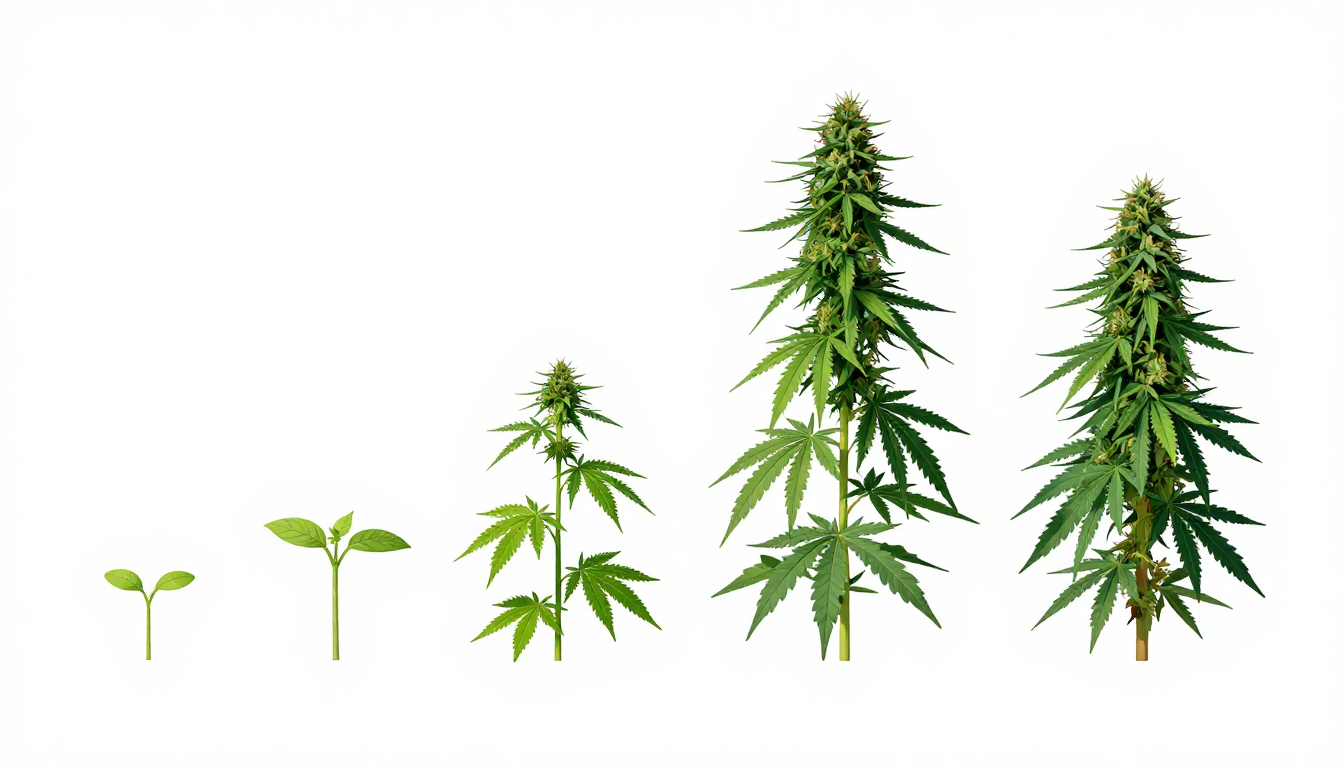
⚡ Total Timeline
Seed to harvest takes 8–16 weeks depending on strain and veg time. Autoflowers: 8–12 weeks total. Photoperiod indicas: 10–14 weeks. Photoperiod sativas: 14–20 weeks. The biggest variable is how long you veg — longer veg = bigger plants = more yield.
Jump to Stage
Germination
The seed cracking open and sending out its first root (taproot). The most critical window — oxygen, moisture, and warmth are everything.
✅ Key Tasks This Stage
- ✓Paper towel method: place seeds between damp paper towels in a dark, warm spot
- ✓Check every 12 hours — seed should crack within 24–72 hours
- ✓Tap root should be 0.5–1cm before planting
- ✓Plant root-down, 0.5–1cm deep in lightly moistened soil or starter cube
- ✓Cover lightly — seedling will emerge in 1–4 days
⚠️ Watch For
Tap root should be white, not brown. Brown = rot. Start over.
💊 Nutrients
None
Seedling
First single-finger leaves (cotyledons) appear, followed by the first true fan leaves with cannabis's characteristic serrated edges. Fragile stage — overwatering is the #1 killer.
✅ Key Tasks This Stage
- ✓Keep lights 50–60cm away (LED) to prevent light burn on tiny plants
- ✓Water only when top 1–2cm of soil is dry — tiny plants need tiny amounts
- ✓No nutrients for first 2 weeks — seed contains all it needs
- ✓Ensure good airflow but not direct fan blast on seedlings
- ✓Watch for stretching (too much distance from light = long, thin stem)
⚠️ Watch For
Damping off (seedling falls over at soil level) = overwatering or poor drainage. Tighten watering schedule.
💊 Nutrients
None or ¼ strength max
Vegetative (Early)
Explosive leaf and root growth. Plant is building its structure. This is when training starts. The plant is at its most resilient here — able to recover from mistakes quickly.
✅ Key Tasks This Stage
- ✓Begin LST or other training when 4–5 nodes are established
- ✓Increase light intensity as plant grows larger
- ✓Start nutrients: nitrogen-heavy formula (e.g. 3-1-2 NPK)
- ✓Top or FIM if using those techniques at node 5
- ✓Monitor runoff pH — should be 6.0–7.0 (soil)
⚠️ Watch For
pH drift (yellowing lower leaves despite feeding = check pH first). Pests start here — check undersides of leaves weekly.
💊 Nutrients
Start at ¼ strength, increase to ½ strength. High N.
Vegetative (Late)
Plant reaches its full vegetative size. Final training. Scrog screens fill up. Pre-flower pistils may appear (white hairs) showing sex, even in veg.
✅ Key Tasks This Stage
- ✓Continue LST and SCROG training — fill canopy
- ✓Lollipop lower branches that won't receive light in flower
- ✓Check sex: female = white pistils, male = pollen sacs (remove males)
- ✓Defoliate strategically for light penetration in dense canopy
- ✓Flip to 12/12 when plant is 50% of desired final height (will double in flower)
⚠️ Watch For
Males! Remove immediately to prevent pollination. Pre-flower check at node 4–6 for white hairs (female) or small round sacs (male).
💊 Nutrients
Full strength vegetative nutrients. Maintain high N.
Transition (Stretch)
The 'stretch' phase — plant can double in height in 2 weeks as it transitions to flowering. White pistils appear everywhere. The beginning of bud site formation.
✅ Key Tasks This Stage
- ✓Switch light schedule to exactly 12 on / 12 off — ANY light leak can cause hermaphrodites
- ✓Raise lights as plant stretches rapidly
- ✓Switch nutrients to bloom formula (lower N, higher P and K)
- ✓Continue SCROG training as new growth emerges above net
- ✓Stop all high-stress training after week 1 of flower
⚠️ Watch For
Light leaks during dark period = hermaphrodites. Use black tape on any blinking LEDs, timers, or gaps in tent.
💊 Nutrients
Transition to bloom nutrients — reduce N, increase P/K
Flowering (Mid)
Buds forming and stacking rapidly. Trichomes visible under a loupe. Pistils (hairs) are white and standing. Plant smell intensifies dramatically.
✅ Key Tasks This Stage
- ✓Support heavy branches with stakes or SCROG net
- ✓Add Cal-Mag if using coco or RO water
- ✓Defoliate lightly if canopy is too dense — 20% max
- ✓Watch for bud rot in dense flowers (botrytis) — increase airflow
- ✓First trichome check with loupe: all clear/cloudy at this stage
⚠️ Watch For
Bud rot (grey mold inside dense buds) = reduce humidity immediately below 45%. Check inside colas not just outside.
💊 Nutrients
Full bloom nutrients. Calcium and magnesium supplementation.
Flowering (Late Ripening)
Maximum resin production. Buds swelling to final size. Trichomes transitioning from cloudy to amber. Pistils browning and receding. Most important window for harvest timing.
✅ Key Tasks This Stage
- ✓Use jeweler's loupe (60–100×) or digital microscope daily
- ✓Flush: run 2–3× pot volume of plain pH'd water through soil
- ✓Lower temperature by 5°C in last 2 weeks to boost color and resin
- ✓Reduce humidity to 30–40% — mold risk highest now
- ✓Stop all nutrients 7–14 days before harvest
⚠️ Watch For
Calyx swelling and pistil recession = harvest approaching. Don't rush — each extra day of ripening increases quality dramatically.
💊 Nutrients
Reduce nutrients, begin flushing 1–2 weeks before harvest
Harvest, Dry & Cure
Harvest timing, trimming, drying, and curing are where most of the final quality is made or destroyed. A perfect grow ruined by a bad dry/cure is heartbreaking.
✅ Key Tasks This Stage
- ✓Trichome harvest window: 80–90% cloudy trichomes = peak THC. Amber trichomes = more sedating/relaxing high
- ✓Harvest at lights-off (or just before) for maximum terpene preservation
- ✓Wet trim (before dry) for faster results; dry trim for better flavor
- ✓Hang whole plants or branches upside down in dark room
- ✓Dry slowly: 7–14 days at 18–21°C, 45–55% RH — slower = better
- ✓Cure in glass jars: burp (open) jars 2× daily for first 2 weeks, then weekly for 4–8 weeks
⚠️ Watch For
Drying too fast (less than 7 days) = harsh, grassy taste. Hay smell = too fast. Patient cure (8+ weeks) turns good into exceptional.
💊 Nutrients
None
🔬 Reading Trichomes — Harvest Timing
Use a jeweler's loupe (60–100×) or digital microscope to check trichomes on the calyxes — not the leaves. Leaf trichomes mature faster and give false readings.
Optimal harvest: 70–80% cloudy + 10–20% amber = peak potency with a balanced high. All cloudy = ceiling potency but more cerebral. Mostly amber = more sedating, body high.